
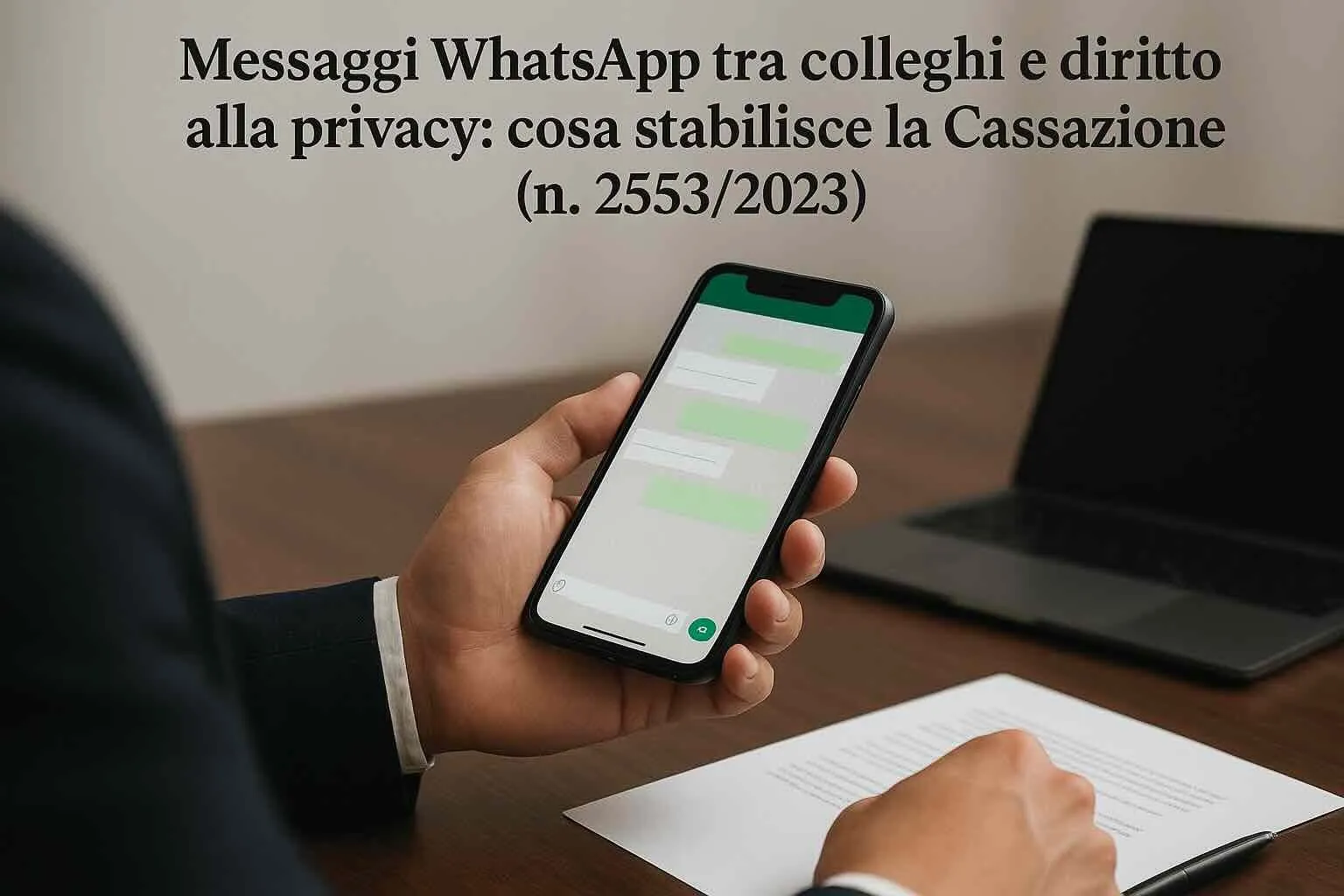
The Court of Cassation, with judgment no. 2553 of January 31, 2023, addressed a highly topical issue: the use of WhatsApp messages exchanged between colleagues as evidence in disciplinary matters and, in particular, as a basis for dismissal. The decision represents an important reference point in the field of privacy in employment relationships, clarifying the limits of the employer's control power.
The principle affirmed by the Supreme Court
According to the Court, messages exchanged in a WhatsApp chat between employees fall fully within the realm of private correspondence. They are intended for a limited and specific number of people, similar to a confidential communication. For this reason, such contents are protected by the right to privacy and confidentiality of communications, guaranteed by the Constitution and the Privacy Code.
The employer's access to messages contained in a private chat, in order to use them as a basis for disciplinary action or dismissal, has therefore been deemed unlawful, except in exceptional circumstances that justify an invasive intervention in this sphere.
Why the dismissal was considered unlawful
In the examined case, the employer had acquired the WhatsApp chat messages and used them to challenge the employee on some statements considered harmful to the company. However, the Supreme Court held that:
• the chat was not public, but reserved for a small group of colleagues;
• the messages could not be equated to publicly disseminated statements;
• the company had no right to access and use such content.
In the absence of authorization, mandate, or particular reasons of urgency or protection of other fundamental rights, the control carried out by the employer was invasive and contrary to privacy regulations.
Reinstatement of the worker and privacy protection
The consequence of the decision was the reinstatement of the worker. The Court reiterated that the right to privacy prevails over the organizational and disciplinary needs of the company, unless there is a concrete and proven just cause that legitimizes an exception. The legal system recognizes, in fact, the centrality of the protection of the person even in subordinate employment relationships.
Practical implications for companies and workers
This decision has a significant impact on both employers and employees:
• For employers: the power of control must be exercised with respect for privacy. Access to private communications is not allowed without a legitimate legal basis.
• For employees: communication in private chats is protected, but it remains essential to maintain proper behavior. Protection does not cover illegal or seriously defamatory acts.
Conclusions
Judgment no. 2553/2023 of the Court of Cassation represents an important clarification: WhatsApp chats between colleagues are private correspondence and cannot be freely acquired by the employer for disciplinary reasons. The improper use of such messages by the company makes the dismissal unlawful and entails the reinstatement of the employee.
The principle is clear: even in the workplace, the protection of privacy remains a fundamental right and cannot be sacrificed except in the presence of exceptional, concretely demonstrable reasons.
Private investigations, conducted in compliance with privacy regulations and the confidentiality of communications, can be a legitimate tool for verifying unlawful or harmful behaviors without resorting to invasive or unauthorized checks.
Comments
Be the first to leave a message.
Thanks, your message is live.
Thanks, your message is awaiting moderation.