
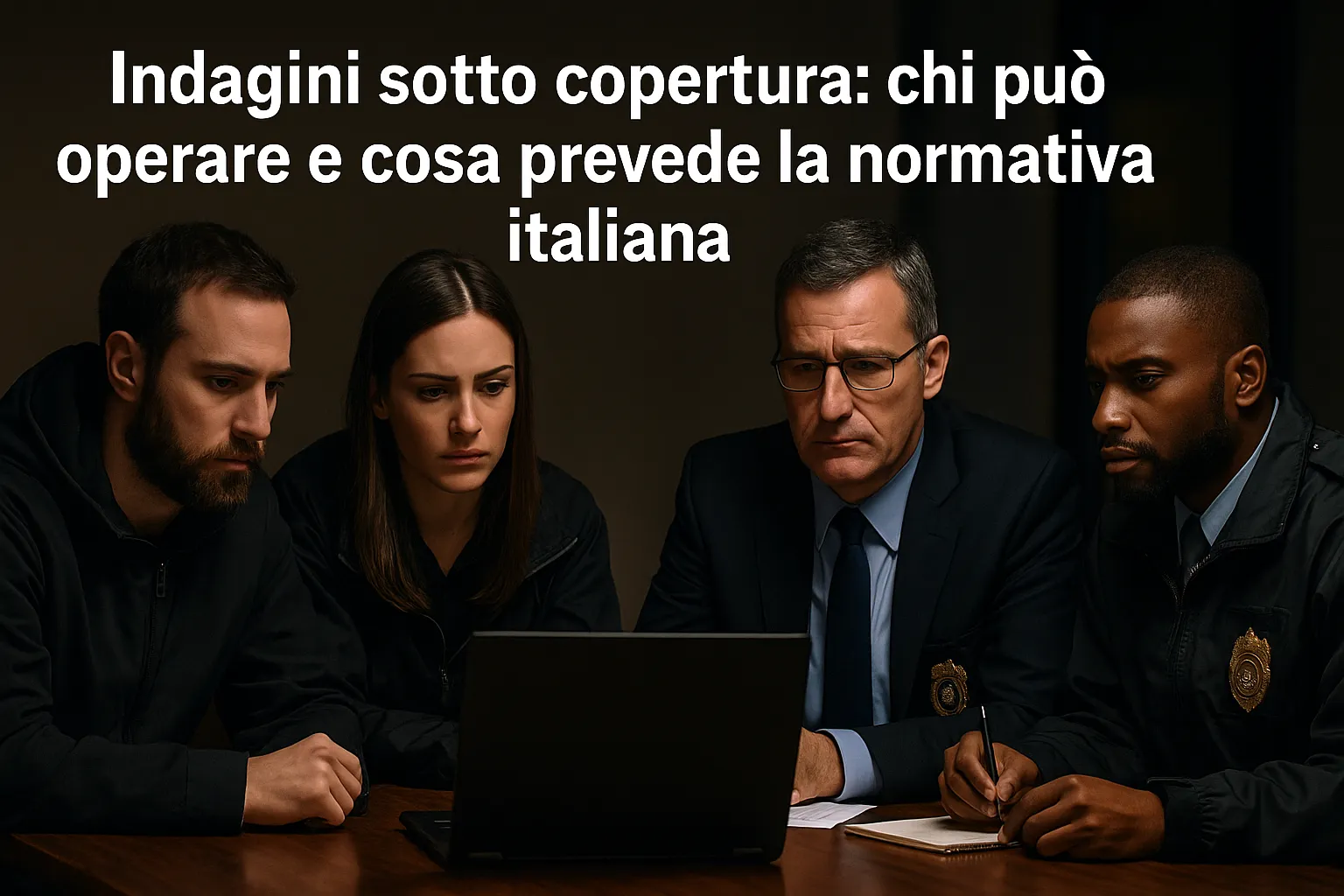
In the fight against organized crime, drug trafficking, and child pornography, undercover investigations represent a fundamentally important investigative tool.
However, in Italy, such activities are reserved exclusively for specialized units of the Judicial Police , subject to authorization from the judicial authority.
Departments authorized to operate undercover
Not all police officers can perform undercover activities.
Italian regulations authorize only specific operational units trained, equipped with adequate preparation and legal coverage:
• ROS – Special Operational Group (Carabinieri)
• GICO – Organized Crime Investigation Group (Guardia di Finanza)
• SCO – Central Operational Service (State Police)
• Postal and Communications Police – Investigative section on cybercrimes and online child pornography
• Other investigative units authorized at the central or district level with specific competencies
These departments operate on behalf of the Public Prosecutor or with authorization from the Investigating Judge, depending on the stage of the proceedings and the nature of the operation.
The Postal Police and undercover online investigations
A central role in digital undercover activities is played by the Postal and Communications Police, particularly through the National Center for Combating Online Child Pornography (C.N.C.P.O.).
This structure specializes in combating cybercrime, with particular attention to child pornography, online child grooming, and the distribution of illegal material on the internet.
The operators of the C.N.C.P.O., authorized by the judiciary, can:
• Assume fictitious identities to infiltrate digital environments
• Simulate interest in child pornography material for investigative purposes
• Collect computer evidence in compliance with privacy regulations and digital evidence preservation
All activities are carried out under strict judicial supervision, with precise protocols to ensure the integrity of the evidence and the legality of the operation.
Who can simulate crimes or fictitious identities?
The simulation of illegal acts or the use of false identities is allowed only to operators belonging to the departments listed above and only in the context of authorized operations. Among the most common activities are:
• The simulated purchase of narcotics
• Undercover interaction in forums or channels for exchanging illegal material
• Fake involvement in illegal trafficking to gather evidence against criminal networks
Anyone outside of these departments who engages in such conduct risks committing offenses, such as identity theft, aiding and abetting, or worse, involvement in criminally relevant acts.
Reference regulations
Undercover investigations are governed by a complex regulatory system that balances investigative effectiveness with constitutional guarantees.
• Law 16 March 2006, no. 146, art. 9 – Undercover operations for organized and transnational crime
• D.P.R. 309/1990, art. 97 – Simulated and controlled operations in the field of narcotics
• Code of Criminal Procedure, arts. 55, 370, 371-bis – Role of the Judicial Police and delegated activities
• Law 1 April 1981, no. 121 – Organization of the Public Security Administration
• Law 38/2006 – Provisions on combating the sexual exploitation of minors
Conclusions
Undercover investigations are an extraordinarily useful tool in the fight against the most insidious crimes, but they require very high standards of professionalism, legality, and confidentiality.
Only authorized departments—such as ROS, GICO, SCO, the Postal Police, and other central or district investigative units—can carry out these operations.
Any activity not regulated by law and without authorization constitutes a violation of the fundamental principles of the rule of law.
Comments
Be the first to leave a message.
Thanks, your message is live.
Thanks, your message is awaiting moderation.