
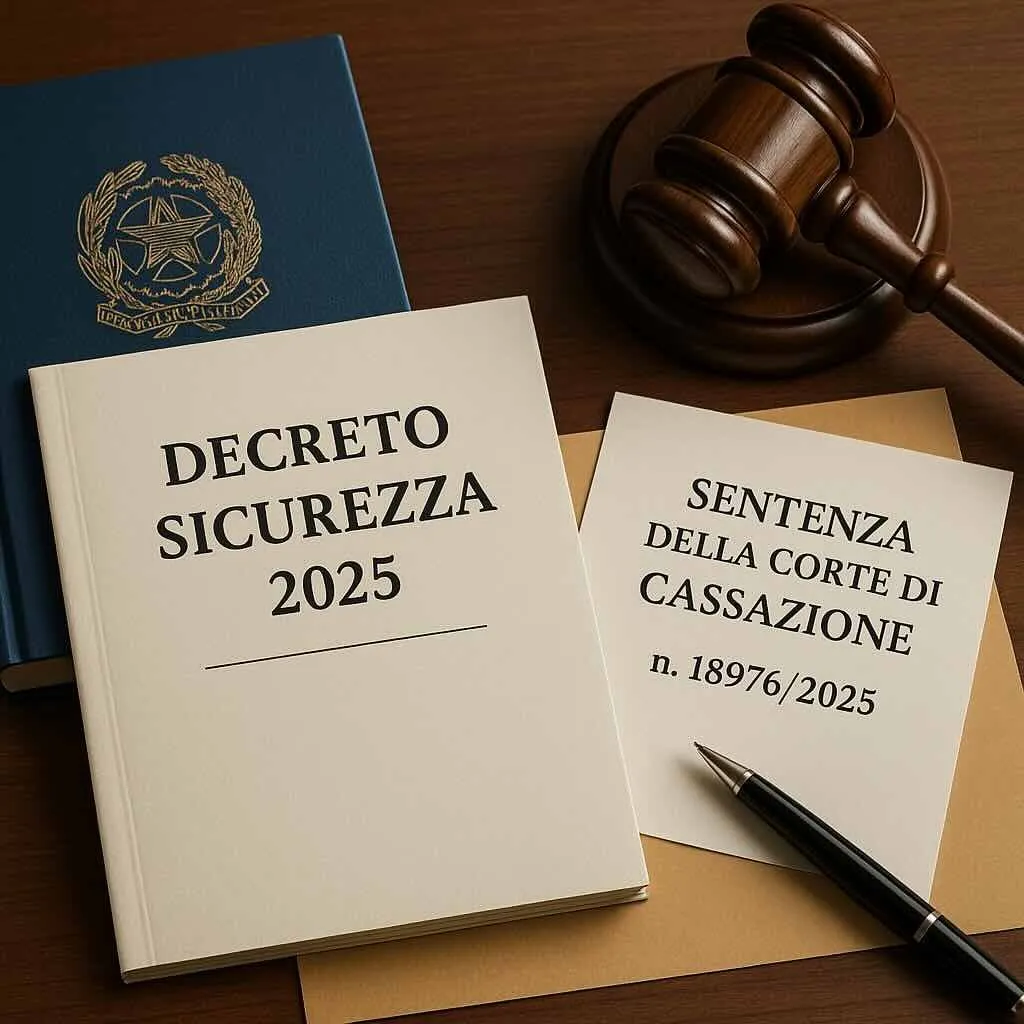
The Security Decree 2025, definitively approved in May and published in the Official Gazette on June 3, 2025, introduces significant changes in public order matters, management of migratory flows, urban security, and strengthening of the powers of law enforcement agencies.
The measure is already at the center of the political and legal debate, also following a recent ruling by the Court of Cassation (judgment no. 18976/2025) that has provided important clarifications on the application of the new provisions.
The main innovations of the Security Decree 2025
Among the most significant changes introduced by the decree are:
• Crackdown on illegal occupations: a simplified procedure is introduced for the eviction of properties occupied without title, with strengthened powers for the Prefects.
• Territorial control: increased funds for municipalities that install video surveillance systems and adopt urban police regulations.
• Accelerated expulsions for non-EU citizens: new reduced timelines are provided for the expulsion of foreigners definitively convicted of serious crimes.
• Integrated databases: greater interoperability between law enforcement databases for more effective tracking of dangerous individuals.
• Protection of police officers: penalties are increased for insult, resistance, and violence against public officials.
The judgment of the Court of Cassation no. 18976/2025
The Court of Cassation – Criminal Section, with judgment no. 18976 of June 18, 2025 (filed on June 26), ruled on an emblematic case concerning the retroactive application of new rules on automatic expulsion of foreigners convicted of crimes against the person.
The case
A non-EU citizen, residing in Italy for over 10 years, had been convicted in 2022 for aggravated assault. Following the entry into force of the Security Decree 2025, the Prefecture had ordered automatic expulsion without assessment of the current danger. The defense had raised constitutional illegitimacy objections for violation of the principle of proportionality and the right to family life (art. 8 ECHR).
The decision
The Court has ruled that:
The automatic expulsion under Security Decree 2025, art. 12, paragraph 3, must still be subject to a proportionality review in light of the individual's concrete situation, in application of constitutional and conventional principles
With this ruling, the Supreme Court states that individual assessment remains essential, even in light of the new provisions. The judgment establishes a firm point in balancing security needs and the protection of fundamental rights.
Implications for legal operators and administrations
This interpretation has important practical implications:
• The Prefectures will have to provide more detailed justifications for expulsion orders, even when foreseen by the decree in an "automatic" form.
• Lawyers will be able to request the annulment of expulsion acts based on a mere mechanical application of the law.
• Local administrations are called to balance the adoption of security measures with respect for the individual and family rights of the persons involved.
Conclusions
The Security Decree 2025 represents a decisive step towards strengthening public order and urban security, but the recent Supreme Court ruling no. 18976/2025 scales back some of its automatic measures, drawing attention to the necessary balance between regulatory rigor and the protection of fundamental rights.
For legal professionals, public operators, and citizens, it will be essential to closely follow the jurisprudential and applicative developments in the coming months.
Comments
Be the first to leave a message.
Thanks, your message is live.
Thanks, your message is awaiting moderation.