
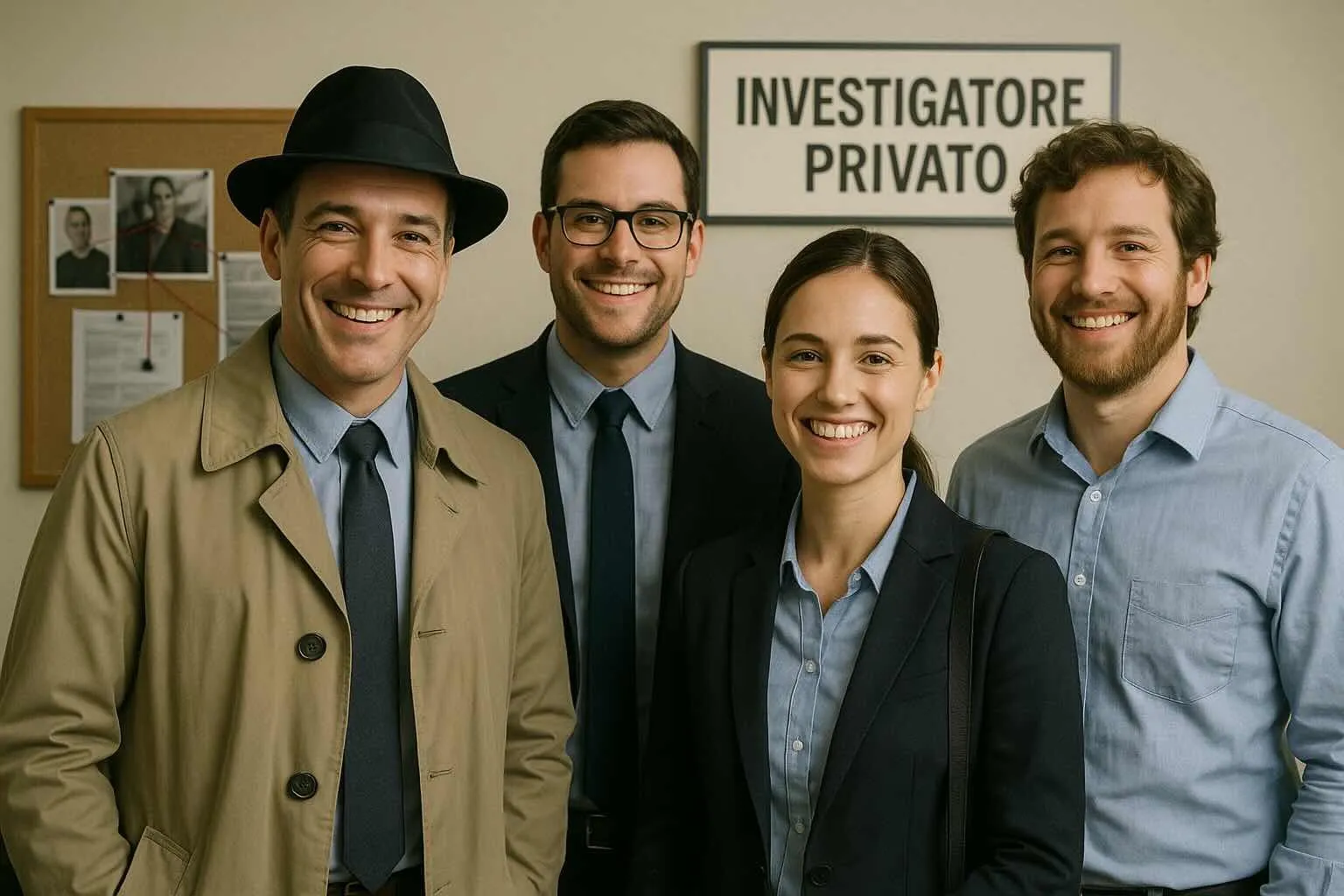
The private investigator is a regulated professional figure in Italy, authorized to conduct investigative activities in civil and criminal matters.
Operates in compliance with the Consolidated Text of Public Security Laws (TULPS), D.M. 269/2010, GDPR, and the rulings of the Data Protection Authority, the provisions of the Code of Criminal Procedure, and the professional ethical standards of the category.
But in addition to the lead investigator, there are two less well-known but fundamental figures: the dependent investigator and the collaborator for elementary investigative assignments (C.I.I.E.).
The professionals authorized to conduct investigations
1. Principal investigator of the institute
He is the legal and operational manager of a detective agency.
The requirements to obtain the Prefectural License are:
• At least a three-year degree in legal, psychological, sociological, economic subjects or in investigative sciences.
• Experience of at least three years as an employee at an investigative institute authorized for at least five years.
• Alternatively, at least five years of experience in the Law Enforcement (discharged without demerit no more than four years ago).
• Attendance of university specialization courses recognized by the Ministry of the Interior.
• Suitable premises, adequate technical and financial capabilities and moral requirements.
2. Employee Investigator
He is the one who conducts complex investigations, assisting the owner. He must:
• Possess a high school diploma.
• Have worked at least 3 years continuously (≥80 hours/month) with an investigator licensed for at least 5 years.
• Attend theoretical-practical courses recognized by the Ministry.
• Be regularly employed by the institute.
3. Collaborator for elementary investigative assignments
It is an operational support figure, introduced by the regulations to perform simple and non-autonomous tasks, such as:
• Surveillance and tailing under supervision.
• Acquisition of information from public databases, publicly available or open sources.
• Logistical support for investigations.
• Must strictly have an employment relationship of subordination with the head of the Institute.
How to become a private investigator
Complete process:
1. Bachelor's/Master's degree in qualifying subjects.
2. Three years of work experience or experience in the Police Forces.
3. Advanced training course recognized by the Ministry.
4. License application to the Prefecture with complete documentation.
5. Opening of the investigative institute with registration at the Chamber of Commerce, premises, insurance, and deposit.
Core competencies
• Observation skills
• Confidentiality and discretion
• Analytical and synthesis skills
• Use of technological tools and investigative software
• In-depth knowledge of regulations and privacy (GDPR)
Comments
Be the first to leave a message.
Thanks, your message is live.
Thanks, your message is awaiting moderation.