
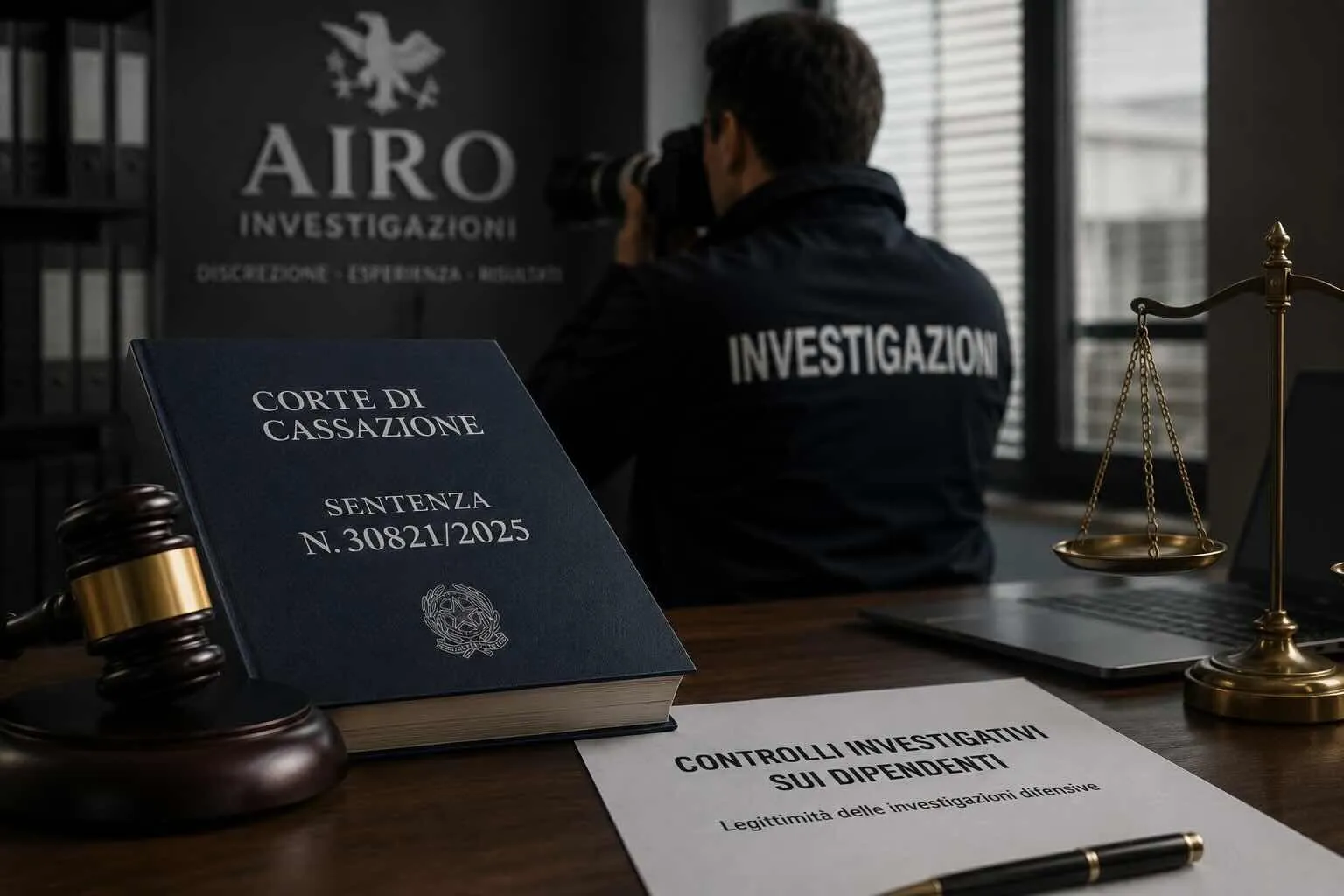
In the modern business world, the boundary between company protection and worker privacy is increasingly delicate. With the Judgment No. 30821/2025, the Court of Cassation reaffirmed a fundamental principle: the employer can rely on a private investigative agency to ascertain illegal behavior by the employee, provided that the investigative activity does not turn into a covert monitoring of normal work performance.
A particularly relevant decision for companies, HR professionals, and private investigation agencies.
Supreme Court Judgment 30821/2025: what happened
The case concerned an employee accused of falsely certifying work activities and movements never carried out during working hours.
The company had hired private investigators to verify the suspicions. The investigations had documented that the worker, instead of performing the declared activities, spent most of the shift sitting in the car.
The Court of Cassation deemed legitimate:
- the assignment to the investigative agency;
- the investigative control;
- the use of the collected evidence;
- dismissal for just cause.
When investigations on employees are lawful
The Court of Cassation confirms an already established orientation: the so-called "defensive controls" are allowed when aimed at ascertaining unlawful behavior.
Private investigations can therefore be used to verify:
- corporate fraud;
- false illness;
- abuse of permits;
- unfair competition;
- embezzlement;
- unlawful use of company assets;
- falsification of employment reports;
- criminally relevant conduct.
In these cases, the private investigator does not merely check the employee's performance but verifies possible illegal activities that could harm the company's assets or image.
When control is prohibited
However, the ruling reiterates a very clear limit.
The private investigator cannot be tasked with:
- verify the ordinary productivity;
- check normal times and methods of performance;
- replace the employer in hierarchical control;
- constantly monitor the employee without concrete suspicions.
In essence:
- control of work performance = prohibited;
- ascertainment of unlawful conduct = permitted.
It is precisely this distinction that determines the legitimacy of the investigative activity.
The value of investigative evidence in court
Another central aspect of Supreme Court Judgment No. 30821/2025 concerns the evidentiary value of private investigations.
The Court confirms that they can be used in court:
- investigative reports;
- photographs;
- video recordings;
- documented observations;
- testimonies of the investigators.
For this reason, it is essential that the investigative activity be carried out:
- in compliance with privacy regulations;
- with a formalized assignment;
- with lawful methodologies;
- by investigators authorized pursuant to art. 134 TULPS.
Corporate investigations: a protection tool for businesses
Corporate investigations today represent a strategic tool for the protection of companies.
Many companies turn to private investigators for:
- fraudulent absenteeism;
- abuse of permits under Law 104;
- corporate infidelity;
- unfair competition by employees;
- misappropriation and disclosure of confidential information.
A properly conducted investigation allows the company to:
- acquire legally admissible evidence;
- limit economic damage;
- prevent further illegal behavior;
- Protect oneself in potential disputes.
Conclusions
The Supreme Court ruling no. 30821/2025 further strengthens the legitimacy of private investigations in the corporate sector, provided they are aimed at detecting illegal activities and not at covertly monitoring regular work activities.
For companies, it becomes essential to rely on authorized investigative institutes, capable of operating with method, discretion, and full evidential validity.
AIRO Investigations operates in the field of corporate investigations, supporting businesses, professionals, and law firms in verifying fraudulent conduct and gathering evidence usable in disciplinary and judicial proceedings.
Comments
Be the first to leave a message.
Thanks, your message is live.
Thanks, your message is awaiting moderation.