
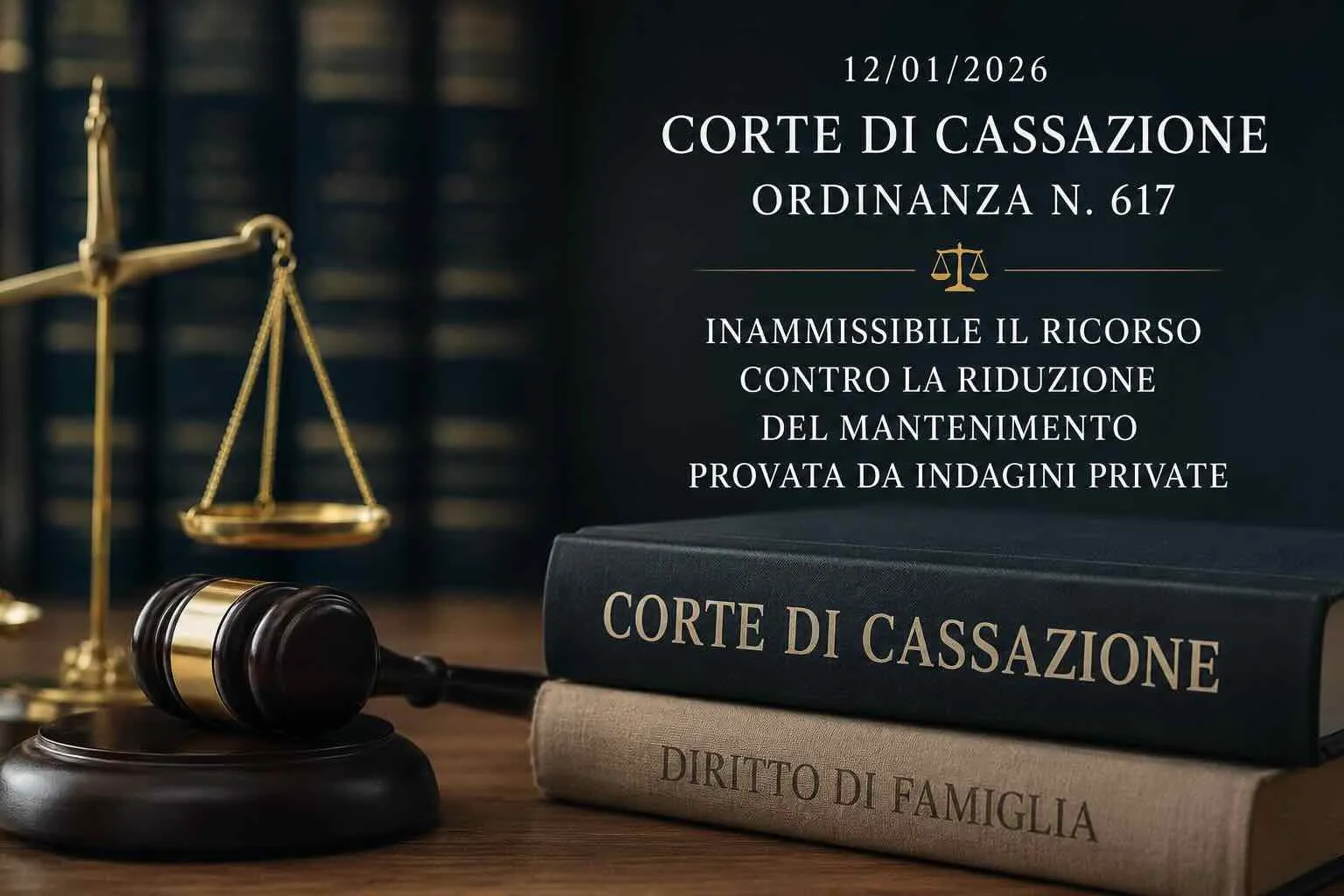
With ordinance no. 617 of January 12, 2026, the Court of Cassation reaffirmed a principle of great importance for family law and for the field of private investigations: investigative reports can constitute valid evidence in judgments related to maintenance allowance.
The Supreme Court has indeed declared inadmissible the appeal filed against a decision that had reduced the maintenance precisely on the basis of the findings carried out by an authorized private investigator.
Investigative reports usable in civil proceedings
According to the Supreme Court, private investigations represent an atypical piece of evidence that can be legitimately assessed by the judge pursuant to Article 116 of the Code of Civil Procedure.
In the examined case:
- the Court of Appeal had reduced the maintenance allowance;
- the decision was based on a private investigative report;
- There were photographs, documented observations, and the investigator's testimony in court.
The former spouse had attempted to challenge the validity of these elements before the Supreme Court, but the appeal was declared inadmissible.
When private investigations affect maintenance
Private investigations are frequently used in separation and divorce proceedings to ascertain:
- undeclared work activities;
- undeclared work;
- cohabitation as if married;
- hidden income;
- standard of living incompatible with what was declared;
- effective economic independence of adult children.
All these elements can affect the determination of the maintenance allowance or its possible revocation.
The investigator's testimony strengthens the evidence
One of the most significant aspects of the ordinance concerns the role of the private investigator in court.
The Court has indeed confirmed that:
- the investigative report can be acquired in the records;
- the judge can attribute full probative value to it;
- The testimonial deposition of the investigator further reinforces the reliability of the investigations carried out.
This principle confirms the professional value of authorized investigative activity and its concrete usefulness in family disputes.
Private investigations and family law
In recent years, private investigations have become an increasingly important tool in family cases.
Often, in fact, one of the spouses:
- engages in unofficial work activities;
- receives undeclared income;
- stably cohabits with a new partner;
- maintains a standard of living incompatible with what was declared in court.
Through observation activities, photographic documentation, and the collection of lawful evidence, the private investigator can provide decisive proof to reconstruct the actual economic and personal situation of the subject in question.
The principle confirmed by the Supreme Court
Ordinance no. 617/2026 consolidates an already stable trend in jurisprudence:
- investigative reports are not just private information;
- constitute evidentiary elements usable in civil proceedings;
- the judge can also base their decision on investigative findings.
For this reason, in proceedings related to separation, divorce, and maintenance revision, investigative activity often represents a decisive tool for uncovering undisclosed economic or personal situations.
When to contact a private investigator
An investigative inquiry can be useful when there are doubts about:
- real employment situation of the ex-spouse;
- stable cohabitations not declared;
- hidden assets or income;
- false unemployment;
- maintenance received unduly.
An investigative activity conducted professionally and in compliance with regulations can produce elements that are concretely usable in court.
Comments
Be the first to leave a message.
Thanks, your message is live.
Thanks, your message is awaiting moderation.